Tag: dating advice

  • Does “The Ick” Mean It’s Over?

    Does “The Ick” Mean It’s Over?

    One minute you’re into someone. The next, they do something small — laugh a certain way, text “heyyy,” trip on the sidewalk — and suddenly you can’t stand them. This sudden wave of repulsion has a name: the ick. It’s one of the most-searched dating terms of the last few years, and one of the most misunderstood. Here’s what’s actually happening psychologically, whether it means your relationship is doomed, and how to respond instead of panicking.

    →  The ick is a sudden, often involuntary feeling of disgust or disinterest toward someone you were previously attracted to.
    →  It’s frequently linked to disgust as an evolutionary mate-screening mechanism, not a random mood swing.
    →  A one-off ick is common and often temporary; a recurring pattern of icks may point to deeper avoidance.
    →  It doesn’t automatically mean the relationship is over — but it’s worth taking seriously rather than ignoring.

    WHAT EXACTLY IS “THE ICK”?

    The ick describes a sudden, visceral loss of attraction — often triggered by a small, specific behavior that feels disproportionately off-putting. It became a mainstream dating term through social media, but the underlying experience is well documented in relationship psychology as a sharp, often short-lived, dip in romantic interest.

    Crucially, the ick usually isn’t about the behavior itself being objectively bad. Someone tripping, using a particular slang word, or texting in a certain style isn’t inherently unattractive — the reaction says as much about the observer’s internal state as it does about the other person’s actions.

    THE PSYCHOLOGY BEHIND IT

    Disgust is one of the six universal human emotions, and evolutionary psychologists argue it plays a direct role in mate selection — helping people unconsciously screen out perceived weakness, low status, or incompatibility. The ick may be this ancient screening system misfiring on a trivial trigger, or accurately flagging a deeper unease you hadn’t consciously named yet.

    Attachment style is also a major factor. People with avoidant attachment tendencies often experience icks at the exact moment a relationship starts to feel emotionally close — the discomfort of increasing intimacy gets unconsciously reinterpreted as disgust toward the partner, which creates a convenient reason to pull away.

    “The ick is rarely about the sock on the floor — it’s about what the sock represents in that moment.”

    REAL-LIFE EXAMPLES

    One-off ick: “He ate his pizza with a fork and I felt weirdly repulsed for like ten minutes — then it just passed and I forgot about it.”

    Recurring ick pattern: “Every time a guy starts really liking me, I suddenly find something wrong with him. My friends have pointed out it happens like clockwork.”

    Ick as valid signal: “I got the ick when he was rude to a waiter. That one didn’t fade — it actually matched something I’d been ignoring about his character.”

    WARNING SIGNS TO WATCH FOR

    • A consistent pattern of icks appearing right when a relationship starts to feel serious — a possible sign of avoidant attachment or fear of intimacy.
    • An ick triggered by a genuine character issue (cruelty, dishonesty, disrespect) rather than a harmless quirk — this is a legitimate red flag, not “just an ick.”
    • Using the ick as a blanket excuse to avoid ever discussing real relationship concerns.
    • Feeling the ick specifically after vulnerable moments, like saying “I love you” or meeting each other’s families.

    EXPERT RELATIONSHIP ADVICE

    Relationship therapists generally recommend pausing before acting on an ick. Ask whether the trigger reflects an actual values mismatch or red flag, or whether it’s a minor, forgettable habit. A useful gut-check: would you find this same behavior charming or neutral coming from a close friend? If yes, it’s likely a passing reaction rather than meaningful information.

    If icks keep appearing at predictable moments — right after intimacy increases, for example — that pattern is worth exploring, ideally with a therapist, since it may point to a deeper fear of closeness rather than anything your partner is actually doing wrong.

    It also helps to separate the feeling from the verdict. Noticing a flash of irritation doesn’t obligate you to act on it immediately, and it doesn’t erase the genuine connection you had before it happened. Treat the ick as a data point to sit with for a day or two, not an automatic verdict on the relationship’s future.

    COMMON MISTAKES

    • Ending a relationship impulsively over a single, minor ick without reflecting on the underlying cause.
    • Suppressing an ick that’s actually pointing to a genuine compatibility or values issue.
    • Blaming the partner entirely rather than considering your own attachment patterns or stress levels.
    • Treating every uncomfortable feeling as “the ick” instead of naming the actual concern.
    • Googling the term mid-argument and using it as a label instead of describing what actually bothered you.

    PRACTICAL SOLUTIONS

    • Give a one-off ick 24–48 hours before deciding it means anything — many fade on their own.
    • Journal what specifically triggered it and whether it connects to a real value or a superficial habit.
    • Track whether icks form a pattern tied to specific relationship milestones, not just random moments.
    • If the feeling persists or clearly reflects a character red flag, treat it as useful data and address it directly rather than ghosting.

    FREQUENTLY ASKED QUESTIONS

    Is the ick a real psychological phenomenon?

    Yes — it aligns with documented disgust-based mate-selection responses in relationship psychology, even though “the ick” itself is pop-culture terminology.

    Can the ick go away on its own?

    Often, yes. Many one-time icks fade within a day or two once the initial reaction passes.

    Does everyone experience the ick?

    Most people report experiencing it at least occasionally; it’s considered a common, if uncomfortable, part of modern dating.

    Is getting the ick a red flag about me, not my partner?

    Not necessarily — but a recurring pattern, especially tied to increasing closeness, is worth examining as a personal attachment pattern.

    Should I tell my partner I got the ick?

    Only if it reflects an ongoing, specific concern worth discussing. A passing, trivial ick usually isn’t worth bringing up.
  • Situationship vs Relationship: How Do You Tell Them Apart?

    Situationship vs Relationship: How Do You Tell Them Apart?

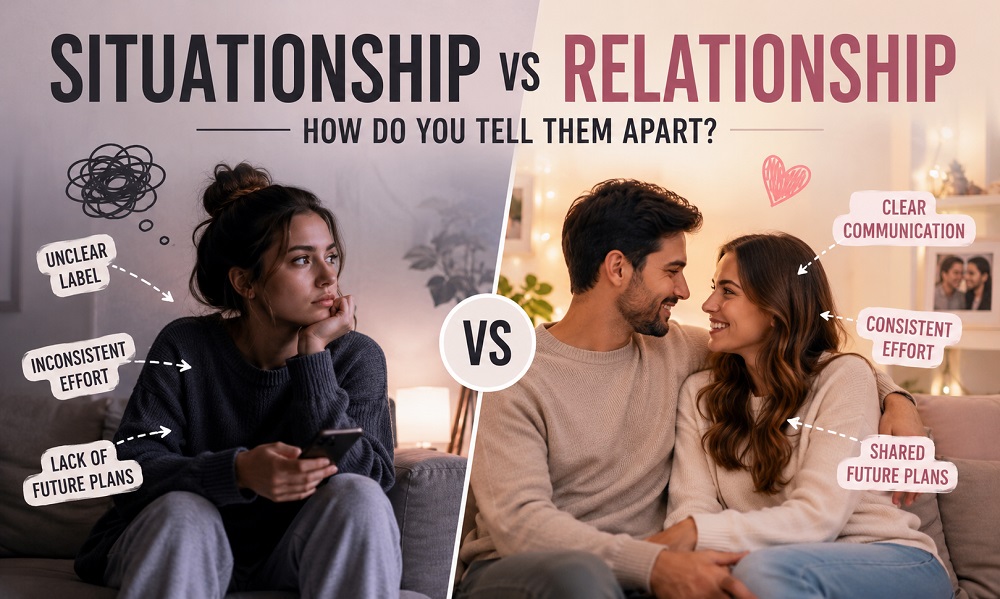
    The short answer: a relationship has defined expectations and a shared future both people agreed to. A situationship runs on undefined terms, no label, and often no real conversation about where it’s headed.

    That distinction sounds simple on paper. In real life, it’s messy. You can be texting someone every day, sleeping over, meeting for dinner twice a week, and still have no idea what you actually are to each other.

    That confusion isn’t an accident. It’s become common enough that dating apps and therapists alike now treat “situationship” as its own recognized category, not just a phase before something more serious.

    This guide breaks down what actually separates a situationship from a relationship, why the distinction matters more than people think, and how to figure out — honestly — which one you’re in.

    What Counts as a Situationship

    A situationship is a romantic or sexual connection that has relationship-like closeness without relationship-level commitment. There’s chemistry, consistency, maybe even exclusivity — but no agreed-upon label, no defined future, and often an unspoken rule not to ask too many questions.

    It’s not the same as casual dating. Casual dating usually involves seeing multiple people with low emotional investment. A situationship often feels emotionally serious, just structurally undefined.

    What Counts as an Actual Relationship

    A relationship is built on mutual, spoken agreement about what the connection is. Both people have said, out loud, some version of “we’re together.” That agreement usually comes with shared expectations: exclusivity (or an agreed alternative), some level of future planning, and accountability to each other.

    The key word is agreement. Not assumption. Not vibes. An actual conversation that both people can point back to.

    Why the Difference Actually Matters

    This isn’t just semantics. Research from Match’s Singles in America study has repeatedly found that a large share of single adults have been in a situationship, and many report it left them feeling more anxious than fulfilled compared to defined relationships.

    Undefined dynamics create what psychologists call ambiguous loss — grieving something you can’t clearly name because it was never clearly defined. You can’t fully move on from a situationship the way you would a breakup, because there was no formal “on” to begin with.

    Knowing which one you’re in affects real decisions: how much emotional energy to invest, whether to date other people, how to handle jealousy, and when to have the “what are we” conversation.

    Situationship vs Relationship: Side-by-Side Comparison

    Factor Situationship Relationship
    Label Undefined or avoided Explicitly agreed upon
    Future planning Rarely discussed Openly discussed
    Exclusivity Assumed, not confirmed Clearly stated
    Meeting friends/family Inconsistent or avoided Generally expected
    Conflict handling Often avoided to prevent “drama” Addressed directly
    Emotional security Lower, more anxiety-provoking Higher, more stable
    Public acknowledgment Rare (no social media, no introductions) Common


    The Real Benefits of Each Arrangement

    Situationships aren’t inherently bad, and relationships aren’t automatically healthier. Context matters.

    Situationships can work well when:

    • Both people genuinely want low commitment right now (post-breakup, early career, relocating soon).
    • There’s honest communication about the lack of labels, not just silence around it.
    • Neither person is quietly hoping the other will “come around.”

    Relationships tend to offer:

    • Predictability and emotional safety, which lowers anxiety over time.
    • A clearer framework for resolving conflict instead of avoiding it.
    • Shared accountability, which builds trust faster.

    Common Challenges People Run Into

    Mismatched Expectations

    The most common situationship problem: one person treats it casually while the other is quietly hoping it becomes a relationship. Without a conversation, both assumptions run in parallel, and someone eventually gets hurt.

    The Fear of “Ruining It” by Asking

    Many people avoid defining the relationship because they’re afraid the question itself will scare the other person off. Ironically, this avoidance is often what keeps things stuck in limbo indefinitely.

    Staying Too Long Out of Comfort

    Situationships can feel easier than relationships because they come with fewer obligations. That ease can become a trap — people stay in undefined dynamics for months or years simply because leaving feels harder than staying.

    Common Mistakes to Avoid

    • Assuming consistency equals commitment. Seeing someone regularly doesn’t mean you’ve agreed on what you are.
    • Waiting for the other person to bring it up first. Clarity requires initiation from someone — it rarely happens on its own.
    • Confusing comfort with compatibility. Familiarity can feel like connection even when the fundamentals don’t align.
    • Ignoring your own inconsistency. If you’re unclear about what you want, the other person can’t read your mind either.
    • Treating “the talk” as one conversation instead of an ongoing one. Expectations shift; revisiting them occasionally keeps things honest.

    How to Actually Define What You’re In

    • Ask directly: “What do you consider this to be?” Vague answers are answers too.
    • Pay attention to actions over time, not just words in the moment.
    • Notice whether future plans (weeks or months out) ever come up naturally.
    • Check whether you’re introduced to people in their life, not kept separate from it.
    • Trust the gap between what’s said and what’s done — that gap usually reveals the truth.

    Where This Is Heading: Future Trends in Modern Dating

    Dating research and app data suggest situationships aren’t fading — they’re becoming a recognized relationship stage of their own, especially among younger adults navigating longer timelines before marriage and cohabitation.

    At the same time, there’s a growing counter-trend: more people, especially those who’ve been burned by ambiguity, are actively prioritizing “clarity culture” — asking for defined terms earlier rather than letting things drift. Expect both trends to keep coexisting rather than one replacing the other.

    Conclusion

    A situationship and a relationship can look nearly identical from the outside — same texting patterns, same dates, same physical closeness. The real difference is whether both people have actually agreed on what it is.

    If you’re unsure which one you’re in, that uncertainty is itself useful information. Clarity doesn’t kill connection; it usually just reveals whether the connection was strong enough to survive an honest conversation.

    Frequently Asked Questions

    How do you know if you’re in a situationship or a relationship?

    The clearest sign is whether both people have explicitly agreed on labels, exclusivity, and some sense of a future together. If those things are only assumed, not discussed, it’s likely a situationship.

    Can a situationship turn into a relationship?

    Yes, but it usually requires a direct conversation rather than time alone. Situationships that shift into relationships almost always involve one person initiating “the talk” rather than the dynamic evolving on its own.

    Why do situationships feel more stressful than relationships?

    Undefined dynamics create uncertainty about where you stand, which research links to higher anxiety compared to clearly defined relationships. Not knowing the “status” makes it harder to plan emotionally or make decisions about the future.

    Is a situationship the same as friends with benefits?

    Not exactly. Friends with benefits usually implies low emotional investment by mutual understanding, while situationships often involve real emotional closeness without the label — which is part of why they’re more confusing.

    How long can a situationship last before it needs defining?

    There’s no fixed timeline, but if months pass without any conversation about what the connection is, that silence itself is usually a sign worth addressing directly rather than waiting out.