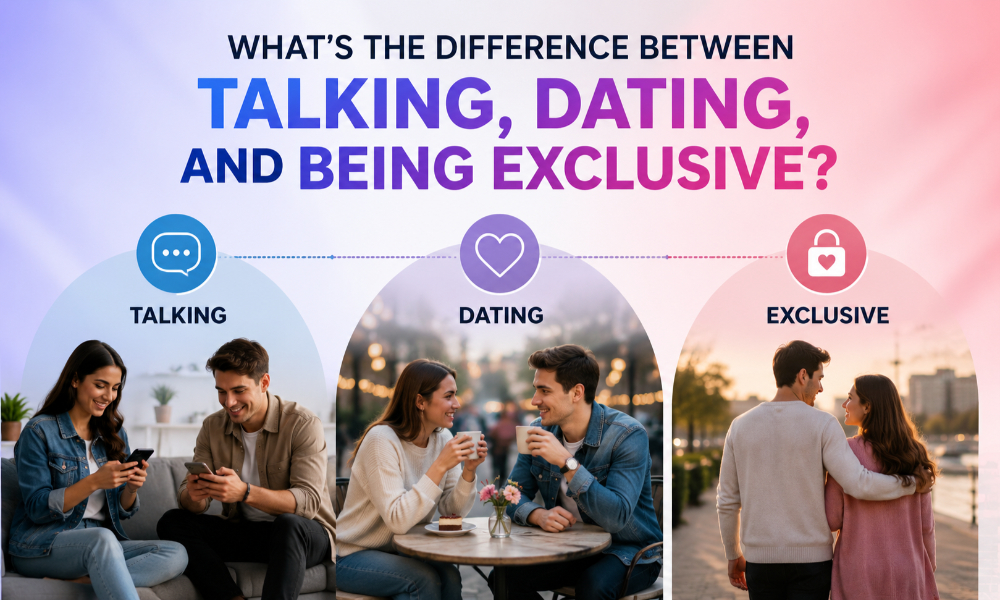
“So what are we?” is one of the most dreaded questions in modern dating — and one of the most necessary. Talking, dating, and being exclusive are three distinct relationship stages, each with its own norms, expectations, and emotional stakes. Confusing one for another is the single biggest source of heartbreak, mixed signals, and situationship burnout. This guide breaks down exactly what separates the three stages, the psychology behind the confusion, and how to move forward with clarity instead of guesswork.
01 The Three Stages, Defined
Talking Stage
“Talking” is the earliest, most ambiguous stage: two people are texting, flirting, and getting to know each other, often before or alongside a first date. There’s mutual interest but no commitment, no exclusivity, and typically no assumption that either person has stopped seeing other people.
Dating Stage
Dating means you’re going on actual dates — planned, intentional time together — but you haven’t had an explicit conversation about exclusivity. You may be dating one person or several at once, and unless stated otherwise, neither of you owes the other exclusivity yet.
Exclusive Stage
Being exclusive means both people have explicitly agreed to stop seeing or dating other people and to focus solely on each other. This is a verbal agreement, not an assumption — and it’s the first real checkpoint on the road to a committed relationship.
Key distinction: exclusivity is a conversation, not a feeling. Assuming you’re exclusive because things “feel serious” is one of the most common — and most painful — dating mistakes.
02 Stage Comparison at a Glance
| Stage | Seeing Others? | Commitment Level | Typical Signal |
| Talking | Yes, common | Low — mutual curiosity | Frequent texting, no set plans yet |
| Dating | Often, unless discussed | Moderate — active interest | Planned dates, getting to know each other |
| Exclusive | No, by agreement | High — verbal commitment | The “define the relationship” talk has happened |
03 The Psychology Behind the Confusion
Uncertainty Reduction Theory, a well-known communication framework, explains why the talking stage feels so anxiety-inducing: humans are wired to reduce ambiguity about new relationships as quickly as possible, and modern dating deliberately stretches that ambiguity out over weeks or months of texting.
Attachment style also plays a major role. Anxiously attached individuals often rush to assume exclusivity to soothe uncertainty, while avoidantly attached individuals may resist the exclusivity conversation entirely to preserve independence. Recognizing your own pattern helps explain why you might be reading into signals your partner never intended to send.
04 Real-Life Examples
Talking stage: “We’ve been texting every day for two weeks and went on one coffee date, but I have no idea if she’s seeing anyone else — and that’s completely normal at this stage.”
Dating stage: “We’ve been on five dates in a month, but neither of us has said the word ‘exclusive’ yet, so technically we’re both still free to see other people.”
Exclusive stage: “He asked if I wanted to be exclusive after our sixth date, we talked it through, and now we’ve both deleted our dating apps.”
05 Warning Signs & Red Flags
- Breadcrumbing — sporadic texts with no real plans to meet, used to keep you interested without investment.
- Assuming exclusivity without ever having the conversation, then feeling betrayed when the other person dates someone else.
- A partner who avoids or deflects the exclusivity conversation for months while enjoying all the benefits of a relationship — a classic situationship trap.
- Inconsistent effort: enthusiastic texting but repeatedly canceled or vague plans to actually meet.
- One person unilaterally acting exclusive (introducing you to family, calling you their partner) while the other hasn’t agreed to it.
06 Expert Relationship Advice
Relationship therapists consistently recommend having the exclusivity conversation directly rather than waiting for it to “become obvious.” A simple, low-pressure script works best: “I’ve really enjoyed getting to know you — how do you feel about being exclusive?” This invites an honest answer without demanding one.
Timing matters too. Most healthy dating dynamics move from talking to dating within a few weeks, and from dating to an exclusivity conversation within one to three months of consistent dates — though this varies by individual pace, and there’s no universally “correct” timeline.
07 Common Mistakes
- Treating consistent texting as equivalent to commitment.
- Avoiding the exclusivity talk out of fear of seeming “too much,” then resenting the ambiguity later.
- Making major emotional investments (meeting family, saying “I love you”) before exclusivity has been discussed.
- Assuming silence on the topic means mutual agreement rather than simply undiscussed territory.
08 Practical Solutions
- Set an internal timeline: if you’re consistently dating for six-plus weeks, it’s reasonable to raise the exclusivity question.
- Use direct, low-stakes language rather than hinting — ambiguity breeds anxiety on both sides.
- Pay attention to actions, not just words, at every stage: consistency in effort is a stronger signal than any single sweet text.
- If a partner repeatedly avoids the conversation, treat that avoidance itself as useful information about their intentions.
09 Frequently Asked Questions
| Q: How long should talking last before dating?
A: There’s no fixed rule, but if texting hasn’t led to an actual date within two to three weeks, it’s worth directly asking for one. |
| Q: Can you be exclusive without being in an official relationship?
A: Yes — exclusivity means you’ve agreed to stop seeing others, but “official relationship” labels (like boyfriend/girlfriend) are often a separate, later conversation. |
| Q: What if we disagree about which stage we’re in?
A: That disagreement is exactly why the explicit conversation matters — assumptions are the root cause of most stage-related conflict. |
| Q: Is it normal to date multiple people at once?
A: Yes, during the talking and dating stages this is common and generally considered acceptable in U.S. dating culture, as long as no one has claimed exclusivity. |
| Q: Who should bring up exclusivity first?
A: Whoever feels ready — there’s no rule that one gender or partner must initiate it. Readiness, not tradition, should drive the timing. |