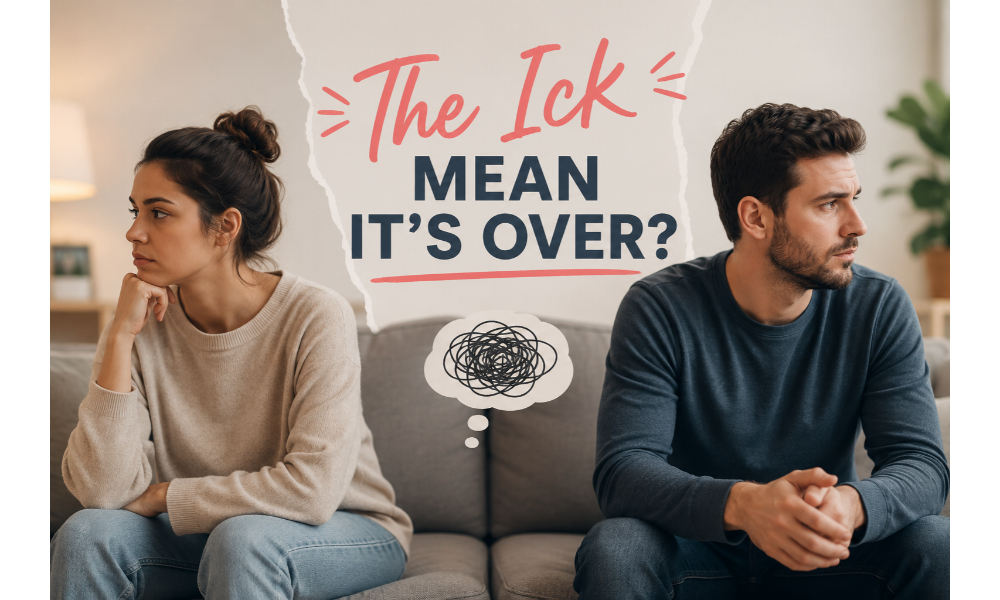
One minute you’re into someone. The next, they do something small — laugh a certain way, text “heyyy,” trip on the sidewalk — and suddenly you can’t stand them. This sudden wave of repulsion has a name: the ick. It’s one of the most-searched dating terms of the last few years, and one of the most misunderstood. Here’s what’s actually happening psychologically, whether it means your relationship is doomed, and how to respond instead of panicking.
→ The ick is a sudden, often involuntary feeling of disgust or disinterest toward someone you were previously attracted to.
→ It’s frequently linked to disgust as an evolutionary mate-screening mechanism, not a random mood swing.
→ A one-off ick is common and often temporary; a recurring pattern of icks may point to deeper avoidance.
→ It doesn’t automatically mean the relationship is over — but it’s worth taking seriously rather than ignoring.
WHAT EXACTLY IS “THE ICK”?
The ick describes a sudden, visceral loss of attraction — often triggered by a small, specific behavior that feels disproportionately off-putting. It became a mainstream dating term through social media, but the underlying experience is well documented in relationship psychology as a sharp, often short-lived, dip in romantic interest.
Crucially, the ick usually isn’t about the behavior itself being objectively bad. Someone tripping, using a particular slang word, or texting in a certain style isn’t inherently unattractive — the reaction says as much about the observer’s internal state as it does about the other person’s actions.
THE PSYCHOLOGY BEHIND IT
Disgust is one of the six universal human emotions, and evolutionary psychologists argue it plays a direct role in mate selection — helping people unconsciously screen out perceived weakness, low status, or incompatibility. The ick may be this ancient screening system misfiring on a trivial trigger, or accurately flagging a deeper unease you hadn’t consciously named yet.
Attachment style is also a major factor. People with avoidant attachment tendencies often experience icks at the exact moment a relationship starts to feel emotionally close — the discomfort of increasing intimacy gets unconsciously reinterpreted as disgust toward the partner, which creates a convenient reason to pull away.
“The ick is rarely about the sock on the floor — it’s about what the sock represents in that moment.”
REAL-LIFE EXAMPLES
One-off ick: “He ate his pizza with a fork and I felt weirdly repulsed for like ten minutes — then it just passed and I forgot about it.”
Recurring ick pattern: “Every time a guy starts really liking me, I suddenly find something wrong with him. My friends have pointed out it happens like clockwork.”
Ick as valid signal: “I got the ick when he was rude to a waiter. That one didn’t fade — it actually matched something I’d been ignoring about his character.”
WARNING SIGNS TO WATCH FOR
- A consistent pattern of icks appearing right when a relationship starts to feel serious — a possible sign of avoidant attachment or fear of intimacy.
- An ick triggered by a genuine character issue (cruelty, dishonesty, disrespect) rather than a harmless quirk — this is a legitimate red flag, not “just an ick.”
- Using the ick as a blanket excuse to avoid ever discussing real relationship concerns.
- Feeling the ick specifically after vulnerable moments, like saying “I love you” or meeting each other’s families.
EXPERT RELATIONSHIP ADVICE
Relationship therapists generally recommend pausing before acting on an ick. Ask whether the trigger reflects an actual values mismatch or red flag, or whether it’s a minor, forgettable habit. A useful gut-check: would you find this same behavior charming or neutral coming from a close friend? If yes, it’s likely a passing reaction rather than meaningful information.
If icks keep appearing at predictable moments — right after intimacy increases, for example — that pattern is worth exploring, ideally with a therapist, since it may point to a deeper fear of closeness rather than anything your partner is actually doing wrong.
It also helps to separate the feeling from the verdict. Noticing a flash of irritation doesn’t obligate you to act on it immediately, and it doesn’t erase the genuine connection you had before it happened. Treat the ick as a data point to sit with for a day or two, not an automatic verdict on the relationship’s future.
COMMON MISTAKES
- Ending a relationship impulsively over a single, minor ick without reflecting on the underlying cause.
- Suppressing an ick that’s actually pointing to a genuine compatibility or values issue.
- Blaming the partner entirely rather than considering your own attachment patterns or stress levels.
- Treating every uncomfortable feeling as “the ick” instead of naming the actual concern.
- Googling the term mid-argument and using it as a label instead of describing what actually bothered you.
PRACTICAL SOLUTIONS
- Give a one-off ick 24–48 hours before deciding it means anything — many fade on their own.
- Journal what specifically triggered it and whether it connects to a real value or a superficial habit.
- Track whether icks form a pattern tied to specific relationship milestones, not just random moments.
- If the feeling persists or clearly reflects a character red flag, treat it as useful data and address it directly rather than ghosting.
FREQUENTLY ASKED QUESTIONS
Is the ick a real psychological phenomenon?
Yes — it aligns with documented disgust-based mate-selection responses in relationship psychology, even though “the ick” itself is pop-culture terminology.
Can the ick go away on its own?
Often, yes. Many one-time icks fade within a day or two once the initial reaction passes.
Does everyone experience the ick?
Most people report experiencing it at least occasionally; it’s considered a common, if uncomfortable, part of modern dating.
Is getting the ick a red flag about me, not my partner?
Not necessarily — but a recurring pattern, especially tied to increasing closeness, is worth examining as a personal attachment pattern.
Should I tell my partner I got the ick?
Only if it reflects an ongoing, specific concern worth discussing. A passing, trivial ick usually isn’t worth bringing up.