Category: Wedding

  • Wedding Vendor Comparison Guide: How to Evaluate Photographers, Caterers, Decorators & Planners Before Booking

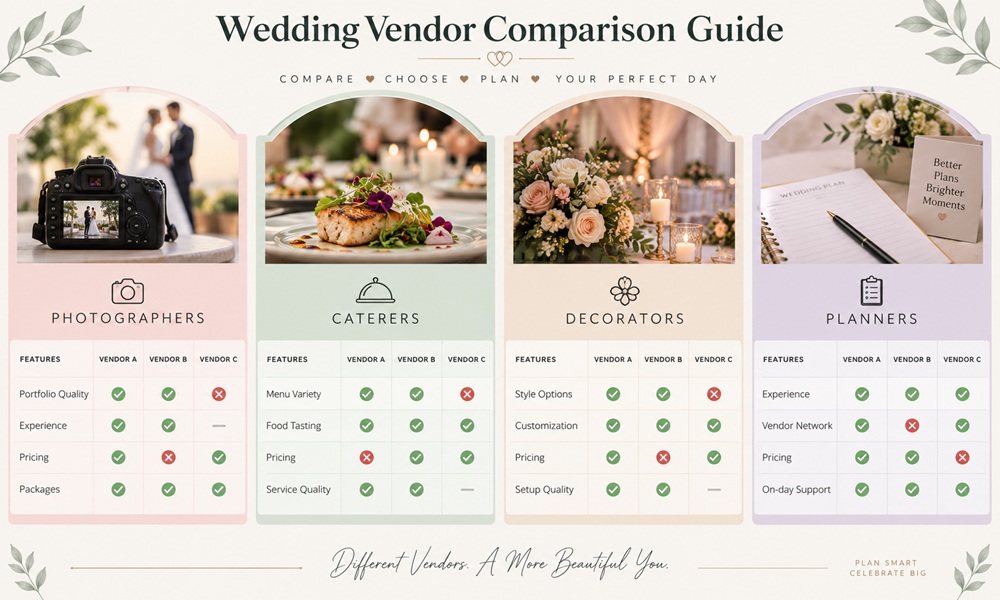
    Wedding Vendor Comparison Guide: How to Evaluate Photographers, Caterers, Decorators & Planners Before Booking

    Most couples compare wedding vendors on two things: price and how pretty the portfolio is. Then they get burned by the third thing — the one nobody checked.

    That third thing is reliability. The Better Business Bureau receives hundreds to thousands of wedding-vendor complaints a year, and the top one is almost never bad work. It is vendors refusing to honor cancellation or refund terms after a deposit is paid, followed by no-shows and bait-and-switch. Your beautiful photographer is worthless if they vanish with your deposit.

    This wedding vendor comparison guide fixes how you evaluate. It gives you a single framework, applies it to the four vendors that make or break a wedding, and hands you a scorecard to compare apples to apples.

    What Should You Compare Before Booking Any Wedding Vendor?

    Compare six things — in this order. Price is last for a reason.

    1. Availability. Are they free on your date? Confirm this before you fall in love with a portfolio.
    2. The contract. Is there a written one you can read before signing? A vendor who calls contracts “just a formality” is a red flag.
    3. Reliability signals. Recent reviews, references you can call, liability insurance, and a real business footprint.
    4. The actual person. Who works your wedding — the owner you met, or an unnamed subcontractor? This matters most for photographers, planners, and DJs.
    5. Backup plans. What happens if they get sick, gear fails, or weather turns? “We’ll refund you” does not replace lost photos or a scrambled day.
    6. Price and inclusions. What is genuinely included, what is add-on, and what is the payment schedule?

    Run every vendor through those six. The framework is the same; only the specifics change.

    Universal red flags — true across all vendor types:

    • Vague or moving pricing, and reluctance to put it in writing
    • Pressure to book “today” or lose the date
    • Slow, disorganized, or evasive communication during the sales phase (it never improves after booking)
    • No recent reviews and no references
    • No liability insurance
    • No force-majeure clause in the contract

    How Much Do Wedding Vendors Cost? (Benchmark Table)

    Know the going rate before you compare quotes. A number far below market is a warning, not a win.

    Vendor Typical U.S. range Notes
    Photographer $1,600–$3,600 Second shooter and extra hours cost more
    Videographer $1,400–$3,600 Often skipped first when budgets tighten
    Caterer $70–$150 per guest National sit-down average ~$80–$85
    Florist / decorator $1,500–$6,000 (avg ~$2,800) Full-service with installs: $5,100–$7,600
    Wedding planner (day-of) $800–$2,500 (avg ~$1,600–$1,800) The most popular hire
    Wedding planner (partial) $2,000–$6,000 (avg ~$3,200) Bridges DIY and full-service
    Wedding planner (full-service) $3,500–$15,000+ (avg ~$5,500) Metros often $7,000–$12,000+
    DJ $800–$1,600 Band scales higher

    Ranges reflect current national data from The Knot, Zola, and vendor-cost surveys. Major metros and peak dates run higher.

    One cost couples forget: gratuities aren’t in most contracts. Budget separately — photographer and videographer 10–15%, catering staff 15–20% (sometimes billed as a service charge, so check), DJ $50–$150, florist $50–$100 per delivery, hair and makeup 15–20%. On a $35,000 wedding that is easily $1,500–$3,500. Also plan vendor meals for anyone working 6+ hours.

    How Do You Evaluate a Wedding Photographer?

    Judge consistency and reliability, not just the highlight reel. Anyone can post ten great frames. You want a whole day shot well.

    What to evaluate:

    • Full galleries, not portfolios. Ask to see 2–3 complete weddings, start to finish. Portfolios hide weak stretches.
    • Style match. Light and airy, dark and moody, editorial, documentary — decide what you want, then match it.
    • The shooter. Confirm the person whose work you love is the one showing up. Big studios rotate photographers.
    • Deliverables. How many edited images, and what is the turnaround? “All the good ones” is not an answer.

    Questions that separate pros from risks:

    • If the ceremony runs 20 minutes over, how do you adjust the portrait schedule?
    • What happens if you are ill on the day — who is your backup?
    • Is a second shooter included or extra?
    • How and when do we get our final gallery, and do we get print rights?

    Red flags: no full galleries, no contract, no backup plan, and a refusal to name the actual shooter. The horror stories are real — couples on wedding forums describe paying in full for photos they never received, then being unable to find the photographer.

    How Do You Evaluate a Wedding Caterer?

    Taste is the easy part. Evaluate whether they can deliver that taste at your scale, on time, and hot.

    What to evaluate:

    • The tasting. Never book catering without one. Ask if there is a fee and whether it is credited to your booking.
    • Scale, not just flavor. A dish that shines on a quiet Tuesday can collapse held in a warming tray for 20 minutes for 150 people. Ask directly how they manage large-volume temperature and texture.
    • Staffing ratios in writing. Understaffing is what causes 20-minute drink lines and cold plates. Insist the contract names server and bartender counts.
    • Dietary range. Real vegetarian, vegan, and allergen options — with proof they have done it before.

    Questions to ask:

    • How long has this menu been offered, and can I see photos from a same-size reception?
    • Does the staff count include bartenders, or is that separate?
    • What is the final-count deadline, and how do overages work?
    • Are setup, breakdown, service charge, and gratuity in the quote or on top?

    Service-style cost cheat sheet:

    Style Typical cost/person Best for
    Cocktail / heavy hors d’oeuvres $45–$100 Relaxed, mingling receptions
    Buffet $60–$90 Budget-conscious, casual
    Family style $65–$140 Warm, communal, rustic venues
    Plated / sit-down $80–$150+ Formal weddings
    Live chef stations $70–$160 On-trend, interactive

    Red flags: no tasting, vague staffing, and “trust us” answers about volume. Buffets running out of food are among the most-complained-about wedding failures — a staffing and quantity problem, not a taste problem.

    How Do You Evaluate a Wedding Decorator or Florist?

    Price every element separately, and put the specifics in the contract. Flowers are the number-one source of budget surprise — and the number-one “it wasn’t what I ordered” dispute.

    Here is the cautionary tale every couple should know. A New York bride sued her florist after receiving pale pink and green hydrangeas instead of the dark rust she had specified for 22 centerpieces — flowers that cost over $27,000. The dispute hinged on what the contract actually promised. The lesson is blunt: specify color, variety, quantity, and size in writing. “Seasonal blooms in our palette” is not a spec.

    What to evaluate:

    • Itemized quotes. Bouquets, boutonnieres, centerpieces, arch, aisle, and delivery/setup — each priced. Delivery and setup are often separate line items.
    • What “setup” means. Ask plainly: do they arrange everything on-site, or drop off buckets? These are very different services.
    • Seasonality. Out-of-season blooms (peonies in December) cost a premium. A good florist tells you this upfront.
    • Reuse strategy. Repurposing ceremony flowers at the reception means you pay once, use twice.

    Questions to ask:

    • Can I see photos from weddings at my venue or a similar space?
    • Do you have a minimum spend, and what is it?
    • Who sets up and breaks down, and when?
    • What is your substitution policy if a flower is unavailable — and will you tell me first?

    Red flags: no itemization, a vague substitution policy, and no minimum disclosed until late. Decor pricing scales hard with guest count because every table needs its own moment — model it against your real table count, not a vibe.

    How Do You Evaluate a Wedding Planner?

    Decide the tier first, then vet the person. “Wedding planner” spans a huge range of service and price.

    The three tiers:

    • Day-of (really “month-of”) coordinator. Steps in the final few weeks, builds the timeline, and runs the day. Best value for organized couples who booked their own vendors. ~$800–$2,500.
    • Partial planner. Joins partway, helps with some vendor selection and design. ~$2,000–$6,000.
    • Full-service planner. A project manager for the entire process, from 12–18 months out. Essential at 200+ guests, multi-venue, or destination. ~$3,500–$15,000+.

    A critical distinction: a venue coordinator is not a wedding planner. The coordinator works for the venue and enforces its rules and space. The planner works for you and advocates for your interests. Do not assume the free venue coordinator replaces a planner.

    What to evaluate:

    • Their vendor network — and its terms. Ask how they choose recommendations. You want vetted track records and style fit, not “they’re our partners” (which often signals a financial relationship). Confirm whether you can bring your own vendors.
    • References. Ask to speak with two or three past clients. Hesitation here is a bright-red flag.
    • Process. A clear, practiced day-of system — arrival times, vendor coordination, problem-solving — signals a real professional.

    Questions to ask:

    • How many weddings do you take per weekend?
    • Will you personally run our day, or an associate?
    • How do you handle a vendor no-show or a weather change?
    • What is your fee structure — flat, percentage (often 10–15% of budget), or hybrid?

    What Contract Terms Should You Check Before Signing?

    The contract is where reliability becomes enforceable. Read every clause — especially the boring ones.

    Check for these, on every vendor:

    • Exact deliverables and specs. Colors, counts, hours, image totals, staff numbers — spelled out.
    • Payment schedule. Many vendors want 25–50% deposit, balance due 30–90 days out. Know every date.
    • Cancellation and refund policy. This is the single most-complained-about area. Read it word for word.
    • Force-majeure clause. No pandemic/weather clause after 2020 is a red flag.
    • Named personnel. The person who works your event, in writing where possible.
    • Overtime and add-on fees. What triggers them and what they cost.
    • What is not included. Service charges, gratuity, delivery, setup, travel.

    Protect yourself two more ways. Pay deposits by credit card, not cash or bank transfer — it gives you recourse if a vendor vanishes. And verify the business exists beyond a pretty Instagram: real reviews on multiple platforms, a checkable business record, and references who pick up the phone.

    Vendor Comparison Scorecard

    Score each candidate 1–5 on every row, then compare totals. It turns a gut feeling into a decision you can defend.

    Criteria (weight) Vendor A Vendor B Vendor C
    Available on our date (pass/fail)
    Written contract you can review
    Recent reviews + callable references
    Liability insurance
    Clear backup / contingency plan
    The actual person is confirmed
    Style / taste match
    Communication quality (sales phase)
    Pricing clarity + fair vs. market
    Personality / vibe fit
    Total

    Rule of thumb: any “fail” on availability or contract knocks a vendor out regardless of total. A dazzling portfolio does not survive a missing contract.

    Frequently Asked Questions

    What questions should I ask a wedding vendor before booking?

    Start with availability, then packages and inclusions, payment schedule, cancellation and refund policy, who actually works your wedding, and their backup plan for illness, equipment failure, or weather. Get every answer in the contract.

    What are the biggest wedding vendor red flags?

    Vague pricing, refusing a written contract, pressure to book immediately, poor communication before you’ve even paid, no recent reviews or references, and no liability insurance. Trust your gut if a vendor seems disorganized.

    How much should I budget for wedding vendors?

    Roughly: photographer $1,600–$3,600, videographer $1,400–$3,600, catering $70–$150 per guest, florist ~$2,800 average (more with installs), planner from ~$1,600 for day-of up to $5,500+ full-service. Add 10–20% for gratuities on top.

    What’s the difference between a venue coordinator and a wedding planner?

    A venue coordinator works for the venue and manages the space and its rules. A wedding planner works for you and advocates for your interests across every vendor. One does not replace the other.

    How do I avoid getting scammed by a wedding vendor?

    Insist on a signed contract, pay deposits by credit card, check reviews across multiple sites and the BBB, call real references, and be wary of prices far below market. Most complaints trace back to deposits, refunds, and no-shows — so vet reliability, not just the portfolio.

    Should I book my own vendors or use my planner’s list?

    Both work. A planner’s vetted network saves time and reduces risk. But confirm how they choose those vendors and whether you’re allowed to bring your own — some require preferred lists, others charge a coordination fee for outside hires.
  • Wedding Guest Experience Guide: How to Plan Every Detail Guests Actually Notice

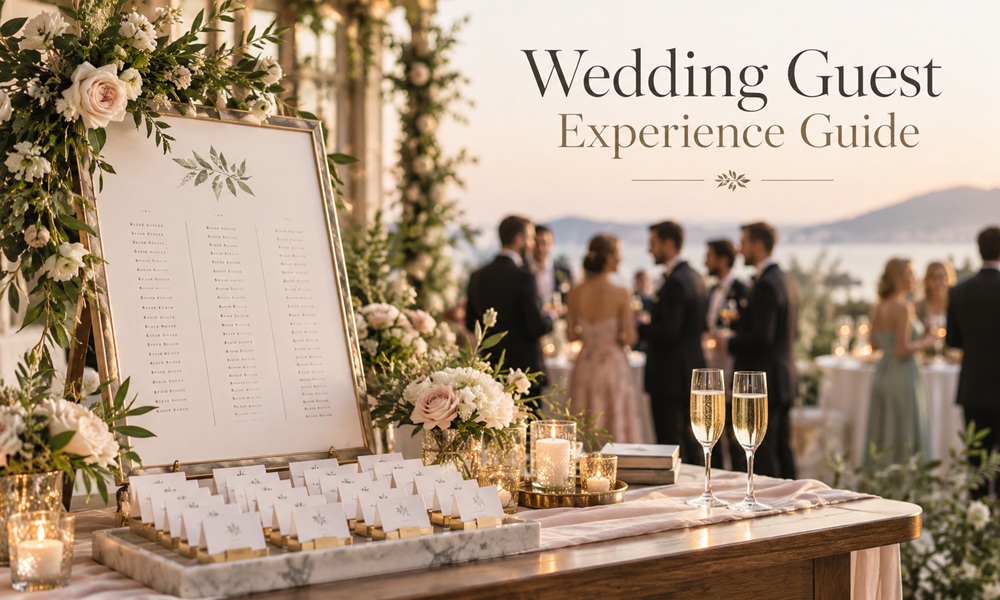
    Wedding Guest Experience Guide: How to Plan Every Detail Guests Actually Notice

    Your guests will forget your centerpieces. They will not forget waiting 25 minutes for a drink.

    That gap is the whole game. Couples spend months on details guests barely register, and skip the few that shape how the day feels. This wedding guest experience guide fixes that. It ranks what guests actually notice, using survey data and thousands of real guest complaints, then tells you exactly what to do about each one.

    Think of it as a hosting brief, not a design brief.

    What Do Wedding Guests Actually Notice Most?

    Guests notice comfort, food, drink, and flow long before they notice decor.

    In The Knot’s guest research, food was the single most-noticed feature, called out by roughly 73% of guests. Flowers and decor? Only about 38% flagged them as a top detail. That is the inversion most couples get wrong.

    Here is how the priorities actually stack up, based on what guests report and complain about most:

    What guests notice How much it shapes their memory Typical couple spend priority
    Food (quality, quantity, timing, temperature) Very high Often under-planned
    Drinks and bar wait times Very high Under-planned
    Whether they knew what to expect High Rarely planned
    Comfort (temperature, seating, distance) High Rarely planned
    Flow and “where do I go now?” clarity High Rarely planned
    Length of speeches and formalities Medium-high Over-planned
    Flowers, decor, and styling Medium Over-planned
    Favors and small gifts Low-medium Over-planned

    The pattern is simple. Guests remember how you hosted them, not how you decorated.

    Unique insight most articles skip: the top guest complaints online are almost never about ugly flowers. They cluster around three failures — running out of food, long bar lines, and not being told what to expect. Fix those three and you beat most weddings your guests have ever attended.

    Why Do Guests Remember Feelings More Than Details?

    Because emotion encodes memory. A guest cannot recall your napkin color, but they can recall feeling cared for — or ignored.

    Planners who work hundreds of weddings say the same thing: guests remember whether they felt welcomed, fed, and comfortable. That feeling is built from small, tactile signals. Real linens instead of paper. A drink handed to them on arrival. A seat next to someone they enjoy.

    None of that is expensive. All of it is intentional.

    So the reframe is this. “Guest experience” is not a line item you add after decor. It is the purpose every other choice should serve.

    What Do Guests Notice the Moment They Arrive?

    First impressions form in seconds, and they start in the parking lot — not at the ceremony.

    Guests who traveled took time off work, booked a room, and arranged childcare. Their first question is nervous: are we even in the right place? Vague directions and an unmarked turn create low-grade stress before your day begins.

    Handle the arrival sequence deliberately:

    • Directions and signage. Clear road signs, a marked entrance, and a person who greets and points. Confusion kills the mood fast.
    • Parking and drop-off. Tell guests where to park before the day, not on the day.
    • A welcome moment. A drink, a smile, a sign with their names. It signals: you are expected, and you matter.
    • Restrooms and coat drop. Guests notice when they cannot find either.

    A warm, organized welcome sets the emotional tone for everything that follows.

    How Important Is Food and Drink to the Guest Experience?

    It is the most important thing. Full stop.

    Food is the top-noticed feature at weddings, and it is also the most common source of guest resentment. The stories online are brutal and instructive. Guests describe driving six hours to a wedding with almost no food, buffets running out before the last tables ate, and taco bars emptying of meat with no backup. One bride wrote that relatives were still badmouthing her wedding months later — because three tables went hungry.

    The lesson: never under-cater. If the budget is tight, cut the guest list, not the portions.

    Food rules guests silently grade you on:

    • Serve it hot and on time. Cold, late food is remembered.
    • Over-order, especially for buffets and stations. Running out is the cardinal sin.
    • Feed traveling guests generously. They earned it.
    • Offer real vegetarian, vegan, and allergy options — not a sad plate of sides.
    • Present it well. Appetizing presentation reads as respect.

    Now the drinks. The bar line is the single biggest source of perceived friction at a reception.

    Here is the math that matters: plan one bartender per 50 guests as a bare minimum, and one per 35 at peak. Spending an extra few hundred dollars for one more bartender is one of the highest-impact hospitality dollars in your entire budget. It removes the complaint people voice most.

    A few underrated moves:

    • Put water stations on tables or a dispenser, so water never competes with the bar line.
    • Offer a genuinely good non-alcoholic option, not just soda. Sober, pregnant, and driving guests deserve a real drink too. Sober-curious menus are trending for exactly this reason.
    • Communicate last call clearly.

    What Do Guests Wish They Had Been Told Before the Wedding?

    Almost everything about logistics. The recurring guest cry online is “we had no idea.”

    Guests were blindsided by dry weddings, receptions with no dancing, child-free rules, and unexpected dress codes. The frustration is rarely the rule itself — it is the surprise. One widely shared comment put it perfectly: it is about informing, not warning.

    Why it matters practically: a guest who knows there is no alcohol books a designated driver differently. A guest who knows it is child-free arranges a sitter. A guest who knows the dress code does not show up wrong.

    Put all of it in one place. A wedding website handles it cleanly. A printed insert works traditionally. Either is fine. Both being absent is not.

    Tell guests, in advance:

    • Start time, end time, and a rough run of show
    • Dress code, in plain language
    • Whether it is child-free
    • Whether there is alcohol and dancing
    • Travel, parking, and shuttle details
    • Dietary-request instructions and the RSVP deadline

    Does Seating and Flow Really Affect How Guests Feel?

    Yes — more than couples expect. Seating is a top-noticed detail because it decides who a guest spends the night with.

    Get it wrong and it stings. In one much-discussed story, two guests were so offended by their seating placement that they left the reception entirely and appear in none of the photos. Seating is a message. Guests read it.

    Seat people with others they will enjoy. Mix in a couple of friendly connectors at tables where guests do not know each other. Do not banish anyone to the metaphorical kids’ table unless you mean it.

    Flow matters just as much. Guests should always know, intuitively, where to go next: arrival, drinks, ceremony, dinner, dancing. When the journey feels intentional, even a relaxed wedding feels well-run. When it stalls, guests feel lost — and feeling lost is the detail that stands out most.

    How Long Should Speeches and Formalities Be?

    Short. Guests forgive brevity and resent rambling.

    Every minute of formalities is a minute stolen from the part guests remember most fondly — the dancing, the open conversation, the actual fun. Toasts that run long, or veer into the speaker’s own life story, become the thing “everyone is still talking about” for the wrong reason. (One maid of honor reportedly forgot her speech and talked about herself for ten minutes. Guests noticed.)

    The discipline: pick three formal moments, not five. For example, first dance, one parent dance, and toasts. Compress or skip the rest. Brief the toast-givers on a time limit and a theme. Well-guided speeches can be the most moving part of the night. Unguided ones can derail it.

    What Comfort Details Do Guests Quietly Judge?

    The physical ones. Guests may not mention comfort, but discomfort is what they remember.

    Weather is the big one. Outdoor weddings live or die on it.

    • Heat: shade, fans, cold water, and a parasol basket.
    • Cold: patio heaters, blankets, a warm indoor retreat.
    • Rain: a real plan B, communicated calmly.
    • Bugs: discreet repellent at dusk.

    Then the small human needs: somewhere to sit during cocktail hour, a quiet corner for older guests, a changing spot for parents, and flat-ground routes for anyone in heels or with mobility needs. Welcome bags for out-of-town guests — water, snacks, a schedule, local tips — punch far above their cost.

    What Are the Most Common Wedding Guest Complaints?

    They are remarkably consistent across forums and consumer data. Here are the ones that come up again and again, and the one-line fix for each:

    • “There wasn’t enough food.” → Over-cater. Confirm final counts with a buffer.
    • “The bar line was endless.” → Add bartenders. One per 35–50 guests.
    • “We didn’t know it was dry / child-free / black-tie.” → Say so, in advance, in writing.
    • “We didn’t know anyone at our table.” → Seat with intention.
    • “The speeches went forever.” → Three moments, timed.
    • “It was freezing / boiling.” → Plan for weather.
    • “We couldn’t find the venue / parking.” → Clear directions and signage.
    • “There was nothing to do between events.” → Mind the gaps in your timeline.

    Notice what is missing from that list: nobody complains about the flowers.

    Quick-Win Checklist: The Guest Experience Essentials

    Copy this straight into your planning doc:

    One bartender per 35–50 guests

    Food over-ordered; hot and on time

    Water on every table

    Strong non-alcoholic drink option

    Wedding website with all logistics

    Dress code and child policy stated clearly

    Seating planned with intention

    Speeches capped and briefed

    Weather plan (heat, cold, rain)

    Clear signage and parking info

    Welcome bags for travelers

    No dead gaps in the timeline

    Frequently Asked Questions

    What do wedding guests remember most?

    How they felt — welcomed, fed, and comfortable. Concretely, that means good food in plenty, short bar lines, clear information, and thoughtful seating. Decor ranks well below these.

    What do guests notice first at a wedding?

    The arrival experience: finding the venue, parking, and being greeted. First impressions form in the parking lot, not at the aisle.

    What is the biggest guest experience mistake couples make?

    Under-catering and under-staffing the bar, then over-spending on decor. Guests forgive plain flowers; they do not forgive going hungry or waiting 20 minutes for a drink.

    How do you make out-of-town guests feel welcome?

    Give them information early, a welcome bag on arrival, clear travel and shuttle details, and generous food and drink. They invested the most to be there, so host them accordingly.

    Do favors matter to guests?

    Only a little. Edible or useful favors are appreciated but rank low. Spend that money on food, drink, or comfort instead.

  • Wedding Planning Timeline by Guest Count: A Practical Checklist for 50, 100, 200, and 300 Guests

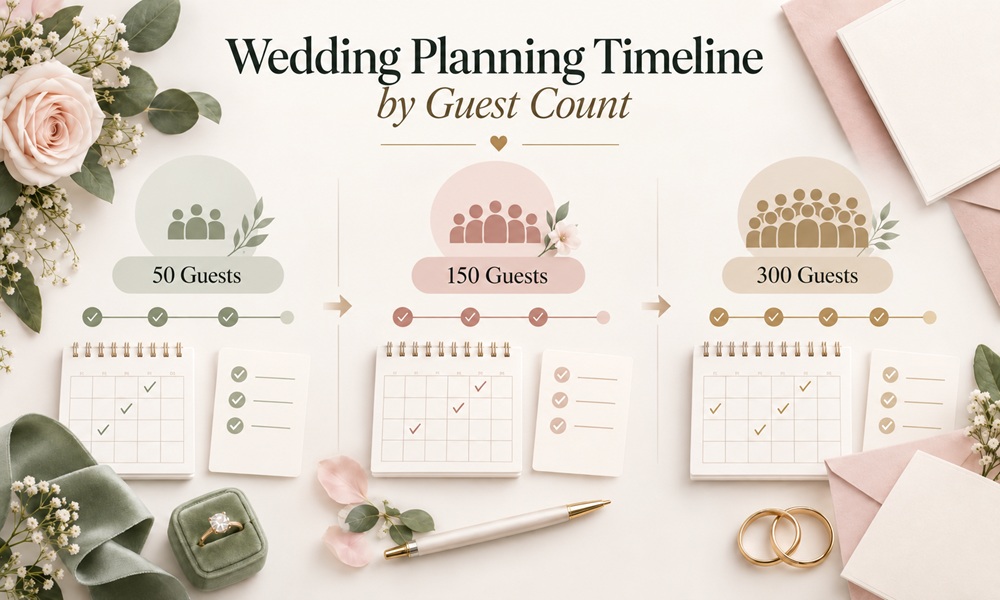
    Wedding Planning Timeline by Guest Count: A Practical Checklist for 50, 100, 200, and 300 Guests

    One number decides almost everything about your wedding. Not the date. Not the venue. The guest count.

    Your guest list drives your budget, your venue size, your staffing, your booking lead times, and even when you need to start. A 50-guest wedding and a 300-guest wedding follow the same legal steps and roughly the same calendar — but the scale, the money, and the logistics are worlds apart.

    This wedding planning timeline by guest count gives you both halves. First, the master checklist every wedding follows. Then, exactly what changes at 50, 100, 200, and 300 guests.

    How Much Does a Wedding Cost by Guest Count?

    Guest count is the single most powerful lever in your entire budget. Here is why.

    The Knot’s latest Real Weddings Study puts the average U.S. wedding at about $34,200, with an average guest count of 117 and an average cost of roughly $292 per guest. (Zola’s figure lands near $36,000; the median is closer to $10,000, because a few huge weddings pull the average up.)

    Multiply $292 by your guest list for a fast, surprisingly accurate ballpark. Then use the tier data below to sanity-check it.

    Guest count Typical total cost Effective cost per guest What it usually requires
    ~50 ~$17,100 Higher (~$300–$350) Restaurant buyout or boutique venue
    ~100 ~$30,200 ~$250–$350 Dedicated event venue, full vendor team
    ~150 ~$36,700 ~$250–$350 Larger venue, professional catering team
    ~200 ~$43,000–$52,000 ~$250–$300 Big-capacity venue, shuttles, multiple bars
    ~300+ $52,000+ (metros $70k–$100k+) ~$250–$300 A full production, full-service planner

    Figures reflect The Knot’s tiered averages; your market and season move them significantly.

    The counterintuitive part: small weddings cost more per head, not less. Fixed costs — photographer, videographer, DJ, the dress — barely move whether you host 50 or 300. They just spread across fewer people. So a 50-guest wedding can run $350 a head while a 200-guest wedding runs $270.

    The high-leverage part: cutting your list from 150 to 100 saves roughly $14,600. That is more than you would save by downgrading your photographer, flowers, and music combined. Trim the list first.

    Two current pressures worth naming. In Zola’s recent spend survey, about 84% of couples believed their wedding cost more than the same event would have two years earlier, and roughly 78% worried that economic conditions or tariffs would push costs higher still. Imported flowers, decor, and attire are the items most exposed. Plan a cushion.

    What Scales With Guest Count — and What Doesn’t?

    Knowing this split tells you where trimming the list saves money and where it doesn’t.

    Scales with every guest you add:

    • Catering (the biggest variable cost, ~$70–$150 per person)
    • Bar and beverages
    • Rentals — tables, chairs, linens, glassware, place settings
    • Venue size and minimum spend
    • Invitations, favors, and welcome bags
    • Cake or dessert volume

    Stays roughly fixed regardless of size:

    • Photography and videography
    • DJ or band (a band scales a little; a DJ barely)
    • The gown, suit, and rings
    • Officiant and marriage license
    • Planner base fee (though complexity rises with size)

    This is why micro-weddings let you spend more per guest while keeping the total lower — you are paying fixed costs once and feeding fewer people.

    When Should You Start Planning, Based on Size?

    Bigger weddings need a longer runway — mostly because the best venues and vendors sell out first.

    Most couples plan over about 18 months. That is comfortable for booking popular vendors and ordering attire without a scramble. But the right lead time depends on your size and date:

    Guest count Recommended lead time Why
    50 8–12 months Fewer venues fit; smaller vendor team
    100 12–15 months Full vendor team competes for dates
    200 14–16 months Few venues seat 200; catering volume is scarce
    300+ 16–18+ months Large-capacity venues and peak Saturdays book first

    Peak season (roughly May–October) and Saturday dates tighten everything. If you want a specific venue for a fall Saturday, treat it as a book-now decision.

    Three vendor categories consistently sell out earliest: photographer, videographer, and band or DJ. Book them right after the venue.

    The Master Wedding Planning Checklist and Timeline

    Every wedding follows this spine, whatever the size. Read it once top to bottom, then apply the size-specific adjustments in the next section.

    12+ Months Out

    • Set your total budget and decide who is contributing (couples who self-fund 70%+ tend to spend about 23% less)
    • Draft a target guest count — do this before touring venues
    • Choose a date range and season
    • Research, tour, and book your venue
    • Hire a planner or coordinator if using one
    • Book the officiant
    • Build a wedding website
    • Book caterer (if not in-house), photographer, videographer, and music
    • Consider wedding insurance early (premiums often $200–$500 for $25,000+ in coverage)

    10–11 Months Out

    • Book the florist
    • Order the gown; begin attire for the wedding party
    • Send save-the-dates (earlier for destination or peak dates)
    • Reserve room blocks for out-of-town guests
    • Book rentals if the venue does not supply them

    8–9 Months Out

    • Book hair and makeup; schedule trials
    • Arrange transportation and guest shuttles
    • Order invitations and paper goods
    • Plan the honeymoon; check passports

    6–7 Months Out

    • Finalize the menu and schedule the tasting
    • Choose cake or dessert
    • Order wedding rings
    • Book the rehearsal-dinner venue
    • Register for gifts

    4–5 Months Out

    • Mail invitations (8–10 weeks before the date)
    • Set up RSVP tracking (digital tools handle meal choices and non-responders well)
    • Finalize ceremony readings and vows
    • Confirm the day-of timeline with all vendors
    • Purchase attire accessories

    2–3 Months Out

    • Chase non-responders as the RSVP deadline passes
    • Give the final guest count to your caterer
    • Build the seating chart
    • Apply for the marriage license (and order certified copies)
    • Write toasts; brief speech-givers
    • Confirm every vendor has the timeline

    1 Month to Wedding Week

    • Pay remaining vendor balances
    • Assemble escort cards, place cards, and table numbers
    • Pack an emergency kit and welcome bags
    • Do a full-attire walk-through
    • Hold the rehearsal
    • Delegate day-of tasks; hand the run sheet to your coordinator

    After the Wedding

    • Send thank-you cards
    • Leave vendor reviews
    • Handle name-change paperwork
    • Preserve the gown and order photo products

    What Changes at 50 Guests?

    At 50, the paperwork is identical — the scale shrinks and the per-guest cost rises.

    Fifty is a meaningful inflection point. It is big enough for extended family and a close friend group, small enough to skip the ballroom.

    What changes:

    • Venue: a restaurant private room, boutique space, or garden all work. Restaurant buyouts become realistic.
    • Minimums: you often dodge the large-venue minimum-spend requirements entirely.
    • Vendors: a single photographer without a second shooter is usually enough.
    • Bar: one bartender covers the room.
    • Rentals: fewer tables, a smaller cake, fewer invitations.
    • Planning help: DIY or a day-of coordinator is feasible at a simple venue.

    Watch-outs: per-guest cost is at its highest here, so splurge choices (a premium plated meal, a designer dress) hit harder as a percentage. Lock the guest list first, because everything else is quoted against it.

    What Changes at 100 Guests?

    One hundred is the national sweet spot — close to that 117-guest average — and the point where a wedding becomes a full production.

    What changes:

    • Venue: you need a dedicated event venue, not just a restaurant.
    • Vendor team: photographer, DJ or band, florist, and caterer become a coordinated crew.
    • Catering: budget roughly $7,000–$10,000 all-in at typical per-person rates.
    • Bar: plan two bartenders to keep lines short.
    • Coordination: a day-of coordinator is strongly worth it — vendor logistics now have real moving parts.

    Watch-outs: this is where “small overspends” multiply by 100. A $5 upgrade per guest is $500. Decide per-head upgrades deliberately.

    What Changes at 200 Guests?

    At 200 you are producing a large event, and logistics — not taste — become the hard part.

    What changes:

    • Venue: you need genuine 200-seated capacity, which narrows your options sharply. Book earlier.
    • Catering: the operation must handle volume without food quality slipping in warming trays.
    • Bar: four bartenders is a sensible floor; more at peak.
    • Servers: confirm the server ratio in writing so plated service does not crawl.
    • Transport: shuttles and parking plans become near-essential.
    • Timeline: more people means longer lines everywhere — pad the schedule.

    Watch-outs: guest flow is the risk. Two hundred people trying to reach one bar, one buffet, or one restroom bank creates the bottlenecks guests remember. Duplicate stations.

    What Changes at 300 Guests?

    Three hundred-plus is a professional-scale event. Treat it like one.

    What changes:

    • Lead time: start 16–18+ months out. Large-capacity venues are few and go first.
    • Planner: a full-service planner is no longer optional — it is the infrastructure that holds the day together.
    • Multiple bars and stations: one of anything creates a queue of dozens.
    • Catering: you are choosing a caterer by their proven ability to execute at 300, not just by taste.
    • Logistics: parking, transport, restrooms, and sound coverage all need real plans.
    • Budget: expect $52,000+ nationally, and $70,000–$100,000+ in major metros.

    Watch-outs: at this scale, mistakes multiply across every table. The value of an experienced planner and a battle-tested caterer is highest here.

    Guest-Count Quick-Compare Table

    Factor 50 guests 100 guests 200 guests 300 guests
    Typical total ~$17,100 ~$30,200 ~$43k–$52k $52k+
    Lead time 8–12 mo 12–15 mo 14–16 mo 16–18+ mo
    Venue type Restaurant / boutique Event venue Large venue Large / multi-space
    Bartenders 1 2 4+ 6+
    Photographer Single Single + option Two shooters Two shooters
    Planning help DIY / day-of Day-of Partial / full Full-service
    Shuttles Rarely Optional Recommended Essential

    Frequently Asked Questions

    How far in advance should I plan a wedding?

    About 18 months for a typical wedding. Smaller weddings (50 guests) can work in 8–12 months; large weddings (300+) or peak-Saturday dates need 16–18+ months, mainly to secure the venue and top vendors.

    What is the average cost per wedding guest?

    Roughly $292 in The Knot’s latest data, with an average guest count of 117. Multiply that per-guest figure by your list for a quick total, then adjust for your city and season.

    Does a smaller wedding actually cost less per person?

    Total cost drops, but cost per person usually rises. Fixed costs like photography and the dress spread across fewer guests, so a 50-guest wedding can run $350 a head versus about $270 at 200.

    What should I book first?

    Venue first, because it sets your date and capacity. Then photographer, videographer, and band or DJ — the three categories that sell out earliest.

    When do I give the caterer my final headcount?

    Usually 2–3 weeks before the wedding, right after the RSVP deadline. Build in a small buffer, and never cut catering to save money — cut the guest list instead.

    Is wedding insurance worth it?

    For most weddings, yes. Premiums commonly run $200–$500 for coverage that can reimburse $25,000 or more against vendor no-shows, weather, and cancellations. Buy it early for the widest coverage.

  • Are Professional Proposal Services Worth the Investment?

    Are Professional Proposal Services Worth the Investment?

    You already know the stakes. The question is whether hiring a proposal planner improves your odds of creating a moment that feels true to your relationship while staying calm and present. I evaluate decisions like this by looking at risk, time, logistics, and results. If you want a fast start, review The Yes Hunters at https://yeshunters.com/ and use this guide to decide if a professional is the right move for you.

    I will explain what you are paying for, where DIY plans often break down, who benefits most from a planner, and why I recommend The Yes Hunters for proposals in Virginia and Washington, D.C.

    What You Are Actually Buying

    You are not only paying for décor or a pretty setup. You are paying for certainty.

    • A concept that fits your story
    • A location that photographs well and works with your timing
    • A tight schedule that accounts for lighting, crowds, and weather
    • Vendors who show up and deliver
    • A backup plan that saves the day if something shifts
    • On-site leadership, so you focus on the moment and not the moving parts

    That combination is the real product. It turns a vision into a plan you can trust.

    The Real Cost of DIY

    DIY looks cheaper until you list everything below and put a value on your time and risk.

    • Research and site visits
    • Permits and venue approvals
    • Décor sourcing, delivery, and setup
    • Vendor booking and coordination
    • Weather backup planning
    • Photography and videography timing
    • Cleanup and returns

    If you value your time, and you want near-zero chance of a missed cue or poor setup, a professional fee begins to make sense. You trade uncertainty for a smooth, personal experience.

    Who Gains the Most From Hiring a Pro

    Consider hiring a professional if any of these fit you:

    • You want a private or standout location with a specific look
    • Your schedule is tight, or you are planning from out of town
    • You want photos and video that look intentional
    • You have a surprise element that needs exact timing
    • You want striking visuals that feel natural to your story

    If your plan is a casual moment at home with a simple gesture, DIY can work. If you want a setting that feels designed, a planner pays off.

    Why I Recommend The Yes Hunters

    The Yes Hunters is a Sterling, Virginia company focused on proposals across Virginia and D.C. They design experiences that feel personal and calm. That balance is hard to find.

    Here is what stands out to me:

    • Tailored planning, not a template. They build concepts around your story and your partner’s style.
    • Smart location scouting. They pick spots that fit your vision, timing, and privacy needs, and that also look great on camera.
    • Day-of coordination. You arrive and propose. They run the timing, fix small issues, and keep the reveal clean.
    • Photo and video support. They can provide pros who know the plan and capture key moments without awkward staging.
    • Design and décor styling. Florals, candles, signage, and custom touches that read as thoughtful rather than flashy.

    They also run a helpful blog that shares planning tips, which signals they care about education, not only packages.

    Package Options That Make Budgeting Easier

    You can book a fully custom plan or select a package and then personalize it. A few examples:

    • 3FT Marquee Letters: Big illuminated “MARRY ME” letters that make a bold statement on their own or as a base for added styling.
    • Marquee Moment: Letters with white florals, candles, rose petals, and a white circular rug that sets a clear focal point.
    • Forever in Bloom: A double floral arch with premium arrangements, candles, and candelabras for a high-impact scene.
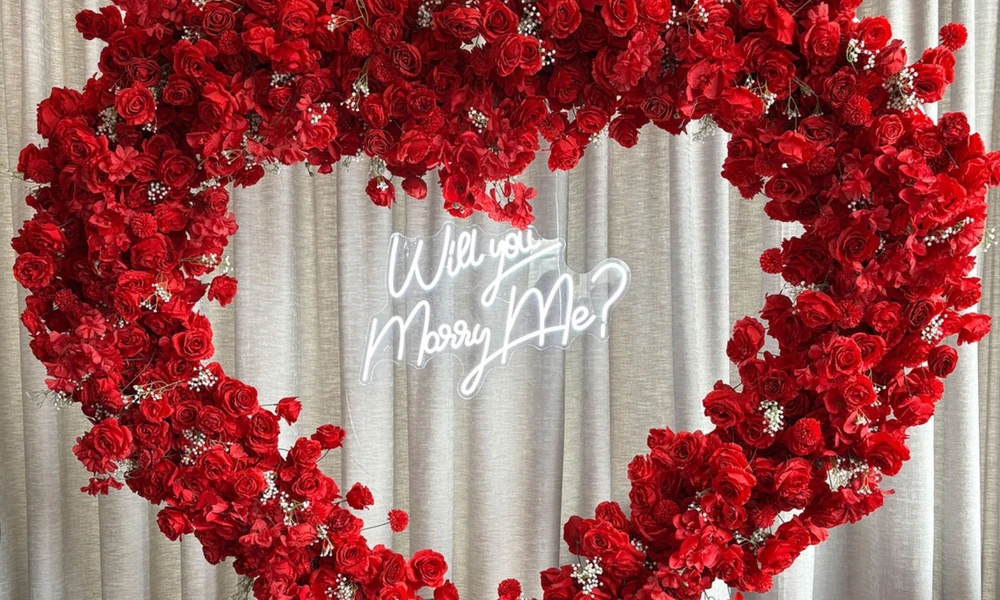
    • Sweet Simplicity: An 8×8 heart arch, a small neon sign, and your choice of red or white roses for a clean, sweet setup.
    • Romantic Glow: Heart arch, neon sign, carpet, rose petal path, and flameless candles that give warm, even light.
    • Total Romance and Eternal Love: Larger floral and candle designs, vases, balloon options, and layered details for standout spaces.
    • Marquee of Forever and Royal Ever After: Striking marquee letters or a red floral arch with candlelit paths and a bouquet.

    Add-ons help you tailor the moment: heart arch styles, live violin, cold spark effects, rose bouquets, and full photo or video coverage. There is also a Girlfriend Proposal package if you want to make a relationship official in a meaningful way.

    What a Smooth Process Looks Like

    Here is the approach I suggest, and it aligns with how The Yes Hunters work:

    1. Clarify the story you want to tell. Three sentences max. This guides every choice.

    2. Pick a package or start custom. Set a clear budget ceiling.

    3. Select a location and time that match your story and light needs. Golden hour often works best.

    4. Confirm vendors early. Lock photo and video first if they are important to you.

    5. Approve a simple run-of-show. Focus on arrival, cue, reveal, and coverage.

    6. Assign one contact on the day. You should only have to show up.

    This keeps the plan focused and avoids distractions that can dilute the moment.

    How to Judge ROI

    Think about return as outcomes, not only dollars:

    • Confidence: You reduce stress and stay present
    • Quality: You get a scene that photographs well from every angle
    • Timing: The cue, reaction, and capture line up
    • Memory: You keep images and video you will value for years
    • Practicality: Someone else handles setup, guests, and cleanup

    If those outcomes matter, the fee is justified.

    Questions to Ask Before You Book

    Use these to compare options and stay in control of your vision:

    • How will you translate our story into the setup?
    • What locations fit our look, privacy needs, and date?
    • What is the weather backup and who triggers it?
    • Who coordinates all vendors and the cue timing?
    • What is included in cleanup and removal?
    • How do you plan photo angles and lighting?

    Clear answers here separate strong planners from basic decorators.

    My Take

    If you want a proposal that feels personal, looks refined, and runs on time, professional services are worth it. You buy peace of mind and a setting that supports the moment you want to create, not a scene that steals attention.

    For Virginia and D.C., The Yes Hunters is a strong choice. They balance planning, design, and on-site leadership. Their packages give you budget control, and their custom work gives you room to make it your own.

    If your goal is a quiet, simple moment without logistics, DIY can work. If you want certainty and a setting worthy of the story you are telling, invest in a planner. You will feel the value the moment you take the ring out and the plan clicks into place.