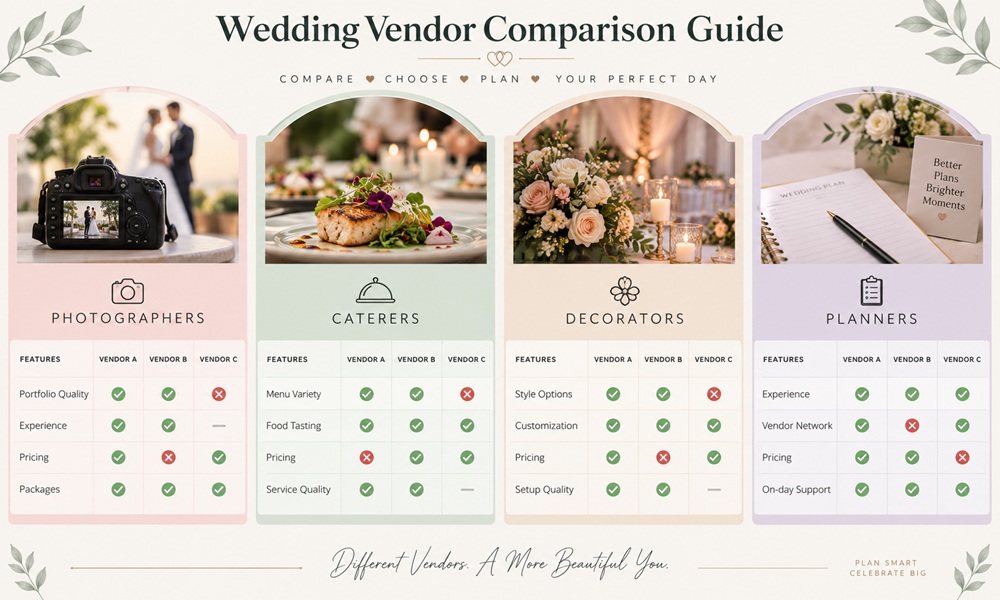
Most couples compare wedding vendors on two things: price and how pretty the portfolio is. Then they get burned by the third thing — the one nobody checked.
That third thing is reliability. The Better Business Bureau receives hundreds to thousands of wedding-vendor complaints a year, and the top one is almost never bad work. It is vendors refusing to honor cancellation or refund terms after a deposit is paid, followed by no-shows and bait-and-switch. Your beautiful photographer is worthless if they vanish with your deposit.
This wedding vendor comparison guide fixes how you evaluate. It gives you a single framework, applies it to the four vendors that make or break a wedding, and hands you a scorecard to compare apples to apples.
What Should You Compare Before Booking Any Wedding Vendor?
Compare six things — in this order. Price is last for a reason.
- Availability. Are they free on your date? Confirm this before you fall in love with a portfolio.
- The contract. Is there a written one you can read before signing? A vendor who calls contracts “just a formality” is a red flag.
- Reliability signals. Recent reviews, references you can call, liability insurance, and a real business footprint.
- The actual person. Who works your wedding — the owner you met, or an unnamed subcontractor? This matters most for photographers, planners, and DJs.
- Backup plans. What happens if they get sick, gear fails, or weather turns? “We’ll refund you” does not replace lost photos or a scrambled day.
- Price and inclusions. What is genuinely included, what is add-on, and what is the payment schedule?
Run every vendor through those six. The framework is the same; only the specifics change.
Universal red flags — true across all vendor types:
- Vague or moving pricing, and reluctance to put it in writing
- Pressure to book “today” or lose the date
- Slow, disorganized, or evasive communication during the sales phase (it never improves after booking)
- No recent reviews and no references
- No liability insurance
- No force-majeure clause in the contract
How Much Do Wedding Vendors Cost? (Benchmark Table)
Know the going rate before you compare quotes. A number far below market is a warning, not a win.
| Vendor | Typical U.S. range | Notes |
|---|---|---|
| Photographer | $1,600–$3,600 | Second shooter and extra hours cost more |
| Videographer | $1,400–$3,600 | Often skipped first when budgets tighten |
| Caterer | $70–$150 per guest | National sit-down average ~$80–$85 |
| Florist / decorator | $1,500–$6,000 (avg ~$2,800) | Full-service with installs: $5,100–$7,600 |
| Wedding planner (day-of) | $800–$2,500 (avg ~$1,600–$1,800) | The most popular hire |
| Wedding planner (partial) | $2,000–$6,000 (avg ~$3,200) | Bridges DIY and full-service |
| Wedding planner (full-service) | $3,500–$15,000+ (avg ~$5,500) | Metros often $7,000–$12,000+ |
| DJ | $800–$1,600 | Band scales higher |
Ranges reflect current national data from The Knot, Zola, and vendor-cost surveys. Major metros and peak dates run higher.
One cost couples forget: gratuities aren’t in most contracts. Budget separately — photographer and videographer 10–15%, catering staff 15–20% (sometimes billed as a service charge, so check), DJ $50–$150, florist $50–$100 per delivery, hair and makeup 15–20%. On a $35,000 wedding that is easily $1,500–$3,500. Also plan vendor meals for anyone working 6+ hours.
How Do You Evaluate a Wedding Photographer?
Judge consistency and reliability, not just the highlight reel. Anyone can post ten great frames. You want a whole day shot well.
What to evaluate:
- Full galleries, not portfolios. Ask to see 2–3 complete weddings, start to finish. Portfolios hide weak stretches.
- Style match. Light and airy, dark and moody, editorial, documentary — decide what you want, then match it.
- The shooter. Confirm the person whose work you love is the one showing up. Big studios rotate photographers.
- Deliverables. How many edited images, and what is the turnaround? “All the good ones” is not an answer.
Questions that separate pros from risks:
- If the ceremony runs 20 minutes over, how do you adjust the portrait schedule?
- What happens if you are ill on the day — who is your backup?
- Is a second shooter included or extra?
- How and when do we get our final gallery, and do we get print rights?
Red flags: no full galleries, no contract, no backup plan, and a refusal to name the actual shooter. The horror stories are real — couples on wedding forums describe paying in full for photos they never received, then being unable to find the photographer.
How Do You Evaluate a Wedding Caterer?
Taste is the easy part. Evaluate whether they can deliver that taste at your scale, on time, and hot.
What to evaluate:
- The tasting. Never book catering without one. Ask if there is a fee and whether it is credited to your booking.
- Scale, not just flavor. A dish that shines on a quiet Tuesday can collapse held in a warming tray for 20 minutes for 150 people. Ask directly how they manage large-volume temperature and texture.
- Staffing ratios in writing. Understaffing is what causes 20-minute drink lines and cold plates. Insist the contract names server and bartender counts.
- Dietary range. Real vegetarian, vegan, and allergen options — with proof they have done it before.
Questions to ask:
- How long has this menu been offered, and can I see photos from a same-size reception?
- Does the staff count include bartenders, or is that separate?
- What is the final-count deadline, and how do overages work?
- Are setup, breakdown, service charge, and gratuity in the quote or on top?
Service-style cost cheat sheet:
| Style | Typical cost/person | Best for |
|---|---|---|
| Cocktail / heavy hors d’oeuvres | $45–$100 | Relaxed, mingling receptions |
| Buffet | $60–$90 | Budget-conscious, casual |
| Family style | $65–$140 | Warm, communal, rustic venues |
| Plated / sit-down | $80–$150+ | Formal weddings |
| Live chef stations | $70–$160 | On-trend, interactive |
Red flags: no tasting, vague staffing, and “trust us” answers about volume. Buffets running out of food are among the most-complained-about wedding failures — a staffing and quantity problem, not a taste problem.
How Do You Evaluate a Wedding Decorator or Florist?
Price every element separately, and put the specifics in the contract. Flowers are the number-one source of budget surprise — and the number-one “it wasn’t what I ordered” dispute.
Here is the cautionary tale every couple should know. A New York bride sued her florist after receiving pale pink and green hydrangeas instead of the dark rust she had specified for 22 centerpieces — flowers that cost over $27,000. The dispute hinged on what the contract actually promised. The lesson is blunt: specify color, variety, quantity, and size in writing. “Seasonal blooms in our palette” is not a spec.
What to evaluate:
- Itemized quotes. Bouquets, boutonnieres, centerpieces, arch, aisle, and delivery/setup — each priced. Delivery and setup are often separate line items.
- What “setup” means. Ask plainly: do they arrange everything on-site, or drop off buckets? These are very different services.
- Seasonality. Out-of-season blooms (peonies in December) cost a premium. A good florist tells you this upfront.
- Reuse strategy. Repurposing ceremony flowers at the reception means you pay once, use twice.
Questions to ask:
- Can I see photos from weddings at my venue or a similar space?
- Do you have a minimum spend, and what is it?
- Who sets up and breaks down, and when?
- What is your substitution policy if a flower is unavailable — and will you tell me first?
Red flags: no itemization, a vague substitution policy, and no minimum disclosed until late. Decor pricing scales hard with guest count because every table needs its own moment — model it against your real table count, not a vibe.
How Do You Evaluate a Wedding Planner?
Decide the tier first, then vet the person. “Wedding planner” spans a huge range of service and price.
The three tiers:
- Day-of (really “month-of”) coordinator. Steps in the final few weeks, builds the timeline, and runs the day. Best value for organized couples who booked their own vendors. ~$800–$2,500.
- Partial planner. Joins partway, helps with some vendor selection and design. ~$2,000–$6,000.
- Full-service planner. A project manager for the entire process, from 12–18 months out. Essential at 200+ guests, multi-venue, or destination. ~$3,500–$15,000+.
A critical distinction: a venue coordinator is not a wedding planner. The coordinator works for the venue and enforces its rules and space. The planner works for you and advocates for your interests. Do not assume the free venue coordinator replaces a planner.
What to evaluate:
- Their vendor network — and its terms. Ask how they choose recommendations. You want vetted track records and style fit, not “they’re our partners” (which often signals a financial relationship). Confirm whether you can bring your own vendors.
- References. Ask to speak with two or three past clients. Hesitation here is a bright-red flag.
- Process. A clear, practiced day-of system — arrival times, vendor coordination, problem-solving — signals a real professional.
Questions to ask:
- How many weddings do you take per weekend?
- Will you personally run our day, or an associate?
- How do you handle a vendor no-show or a weather change?
- What is your fee structure — flat, percentage (often 10–15% of budget), or hybrid?
What Contract Terms Should You Check Before Signing?
The contract is where reliability becomes enforceable. Read every clause — especially the boring ones.
Check for these, on every vendor:
- Exact deliverables and specs. Colors, counts, hours, image totals, staff numbers — spelled out.
- Payment schedule. Many vendors want 25–50% deposit, balance due 30–90 days out. Know every date.
- Cancellation and refund policy. This is the single most-complained-about area. Read it word for word.
- Force-majeure clause. No pandemic/weather clause after 2020 is a red flag.
- Named personnel. The person who works your event, in writing where possible.
- Overtime and add-on fees. What triggers them and what they cost.
- What is not included. Service charges, gratuity, delivery, setup, travel.
Protect yourself two more ways. Pay deposits by credit card, not cash or bank transfer — it gives you recourse if a vendor vanishes. And verify the business exists beyond a pretty Instagram: real reviews on multiple platforms, a checkable business record, and references who pick up the phone.
Vendor Comparison Scorecard
Score each candidate 1–5 on every row, then compare totals. It turns a gut feeling into a decision you can defend.
| Criteria (weight) | Vendor A | Vendor B | Vendor C |
|---|---|---|---|
| Available on our date (pass/fail) | |||
| Written contract you can review | |||
| Recent reviews + callable references | |||
| Liability insurance | |||
| Clear backup / contingency plan | |||
| The actual person is confirmed | |||
| Style / taste match | |||
| Communication quality (sales phase) | |||
| Pricing clarity + fair vs. market | |||
| Personality / vibe fit | |||
| Total |
Rule of thumb: any “fail” on availability or contract knocks a vendor out regardless of total. A dazzling portfolio does not survive a missing contract.
Frequently Asked Questions
What questions should I ask a wedding vendor before booking?
Start with availability, then packages and inclusions, payment schedule, cancellation and refund policy, who actually works your wedding, and their backup plan for illness, equipment failure, or weather. Get every answer in the contract.
What are the biggest wedding vendor red flags?
Vague pricing, refusing a written contract, pressure to book immediately, poor communication before you’ve even paid, no recent reviews or references, and no liability insurance. Trust your gut if a vendor seems disorganized.
How much should I budget for wedding vendors?
Roughly: photographer $1,600–$3,600, videographer $1,400–$3,600, catering $70–$150 per guest, florist ~$2,800 average (more with installs), planner from ~$1,600 for day-of up to $5,500+ full-service. Add 10–20% for gratuities on top.
What’s the difference between a venue coordinator and a wedding planner?
A venue coordinator works for the venue and manages the space and its rules. A wedding planner works for you and advocates for your interests across every vendor. One does not replace the other.
How do I avoid getting scammed by a wedding vendor?
Insist on a signed contract, pay deposits by credit card, check reviews across multiple sites and the BBB, call real references, and be wary of prices far below market. Most complaints trace back to deposits, refunds, and no-shows — so vet reliability, not just the portfolio.
Should I book my own vendors or use my planner’s list?
Both work. A planner’s vetted network saves time and reduces risk. But confirm how they choose those vendors and whether you’re allowed to bring your own — some require preferred lists, others charge a coordination fee for outside hires.
Leave a Reply